Novensia
a brand operating system
In brief
- The problem: brand work asks for multiple specialists, and the tools answer one question each.
- The system: a guided intake, a four-stage voice engine, and a synthesis layer to come.
- The visual half: the same foundation turned into an identity, steered by hand.
- What it has produced: four brands that don't sound or look alike.
- What I built: one person makes the calls; AI does the work under them.
- Where it's going: synthesis, RAG, and the visual half as a built pipeline.
Novensia is a brand operating system in private alpha. The brand foundation (mission, pillars, voice, visual direction) becomes the source of truth that powers everything downstream, from content production on out. It's built for people who are their own brand, and for the agencies, coaches, and consultants who build brands for others.
I designed and built it, working through Claude Code. I run it by hand, on purpose. It stays manual until it has earned the trust to run on its own. Every run ends with me reading the output before anything is used.
The problem
Building a brand asks you to be ten specialists at once: strategist, writer, designer, content producer, marketer. The people who put Novensia to work are one or two of those at most, not all ten. They're founders, coaches, consultants, small business owners, and the agencies that serve them. They know their work. What they don't always know is whether they need a brand pillar, how to word a mission so people take it seriously, or where to start.
The existing tools are feature-level. A logo maker. A palette generator. A content tool. None of them answer the real question: where do I start, and how do I know I'm doing this right?
AI was supposed to fix this. Ask a model for a brand mission cold and you get something generic, because there's no foundation underneath. No record of who you are, what you stand for, how you sound. Audiences can tell.
Novensia is built on the opposite premise: foundation first. The system learns who you are, keeps that record, and uses more than one model checking the other's work so what comes out is grounded in you.
The system
Three layers, in order.
First, the foundation. A guided intake: seven chapters that walk you through who you are, what you believe, who you serve, how you want the brand to look and sound. Each chapter is a run of questions, and each question comes with a short note on how to think about it as you answer, so momentum holds and nothing overwhelms. Autosave on every keystroke. Chapters you can move between freely, because the work doesn't come out in order. It's a capture instrument by design. No AI synthesis at this stage, on purpose: you can't make sense of what you haven't said clearly first.
Then the production tools. The voice and content engine is the first one. Four model stages: it learns how you write from your samples, builds a strategy for what you want to say, generates a draft, then runs a quality pass. Between strategy and drafting, you can review or change the length target. The last stage hands the accepted draft to a second model to score against your voice profile and content brief, identify what's off line by line, and return a revised version with those problems fixed. The score belongs to the original draft; the returned revision is clearly marked as improved but not independently rescored. The draft, critique, and revision are all kept, and you can go back to any of them.
Every stage hands the next one a checked, typed JSON result. If the output doesn't match the contract, the next stage doesn't run.
The model assignments are deliberate and they move as models change. The rule underneath doesn't: the stages that learn your voice and plan run cool, the stage that writes runs warmer, and the model that judges is never the model that wrote. Judgment needs to be sharper than invention.
The voice profile captures techniques, not phrases. "Trained on your voice" usually means remixing sentences from your samples, which is why the result sounds like a karaoke version of you. Novensia learns how you make a point, not the words you used to make it last time.
The third layer, synthesis, is next. It fuses the foundation with the tools, so when the engine writes it draws on your mission, your pillars, and the people you serve, not only your writing samples. The schema already reserves space for it.
Everything attaches to a shared brand record. Intake and engine are siblings, not steps. Use one, the other, or both. The brand is always the source of truth, and it grows as you give it more.
The visual half
The engine writes the words. The other half of the system turns a person, or a company, into a brand identity: the look. Same foundation, different job, and this is the half I steer by hand against the system's logic.
Brand identity work is slow and bespoke, and its quality usually lives or dies on one creative director's taste. That doesn't repeat and it doesn't scale. AI logo makers and brand-kit generators are fast, and speed was never the problem. They have no grounding in the actual person or business and no judgment steering the output, so they produce generic sameness quickly. This half is built to sit between those two failures.
Intake. The same foundation the engine uses, read for what it says about the brand: who they are, what they believe, who they serve, how they talk, what they've lived through. Not a creative brief written to sound good. The actual person or business, in their own words, contradictions left in.
Analysis. This stage returns the strategic core: a set of archetypes, a positioning line, the ground the brand should stand on, a voice. It's the step that turns a person or a company into a brand foundation, and right now it's the step I run by hand, working the system's logic against the intake rather than letting a built pipeline do it.
Direction and build. The foundation becomes a visual system and a deck: type, color, texture, imagery, logo. This is where I art-direct, and where the manual judgment is heaviest. Some of the imagery in these identities is generated, from prompts built out of the brand's own foundation rather than typed cold. The rest, including the layout of every deck, is made by hand.
Each stage hands a real artifact to the next. An intake doc, a foundation doc, a creative-direction doc, a deck. You can open any stage and see what it produced and the reasoning behind it. The brand isn't one opaque output. It's a chain you can audit.
Why it doesn't come out generic
Two things keep the output specific instead of templated.
The analysis is grounded in the brand's real material, not a vibe. The archetypes come from what was actually said and lived, whether that's one person or a company, and the hard constraints in the intake become hard constraints in the art direction. The system isn't guessing at a personality. It's reading one.
And I steer every output with brand judgment. The system proposes; I decide. On one brand that meant catching things the system couldn't: that its type direction was too rigid to build on, that its two chosen colors vibrated against each other, that two of its four archetypes were really one person. The system reads what's written down. I can see what's on the page and know what isn't.
The system can generate. It can't yet tell what's on-brand from what's almost. Until it can, my judgment is the check, and running it by hand is how I see what the model gets right and where it drifts. That's how I get it right before I take my hands off.
What it has produced
Four brands have gone through the system so far: Rory Miller, John Nemo, John Michael Morgan, and Sean Patton. The engine wrote the voice documents; the identity work was steered by hand against the system's logic. Same pipeline, four voices that don't sound alike, four brands that don't look alike. All four are personal brands because that's who came first. The system reads a company the same way.
The clearest proof the system isn't a template is what it does with the same starting point. Sage sits in all four analyses. Nemo's Sage cracks a joke. Rory's is monastic. John Michael Morgan's is a rebel-philosopher. Sean's was forged in combat. The archetype is where the system starts. The person is what it's made of.
Nemo. A LinkedIn lead-generation coach, a former reporter, and funny on purpose. The system returned Sage, with Magician and a merged Everyman-Jester. I built a punk-zine identity: a mismatched, hand-drawn logo, heavy Xerox grain, kraft and a punch red. The loudest of the four. Wisdom that cracks a joke.
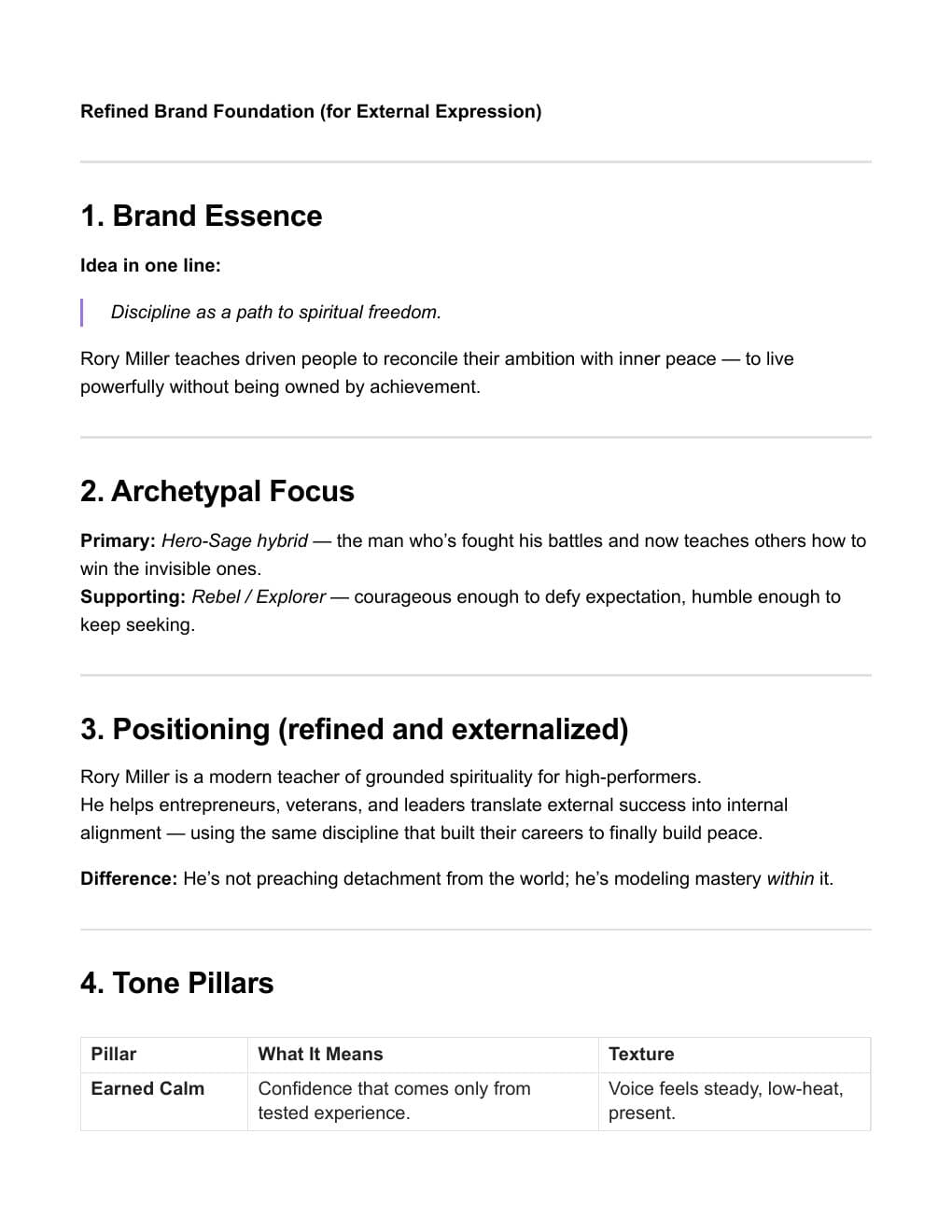
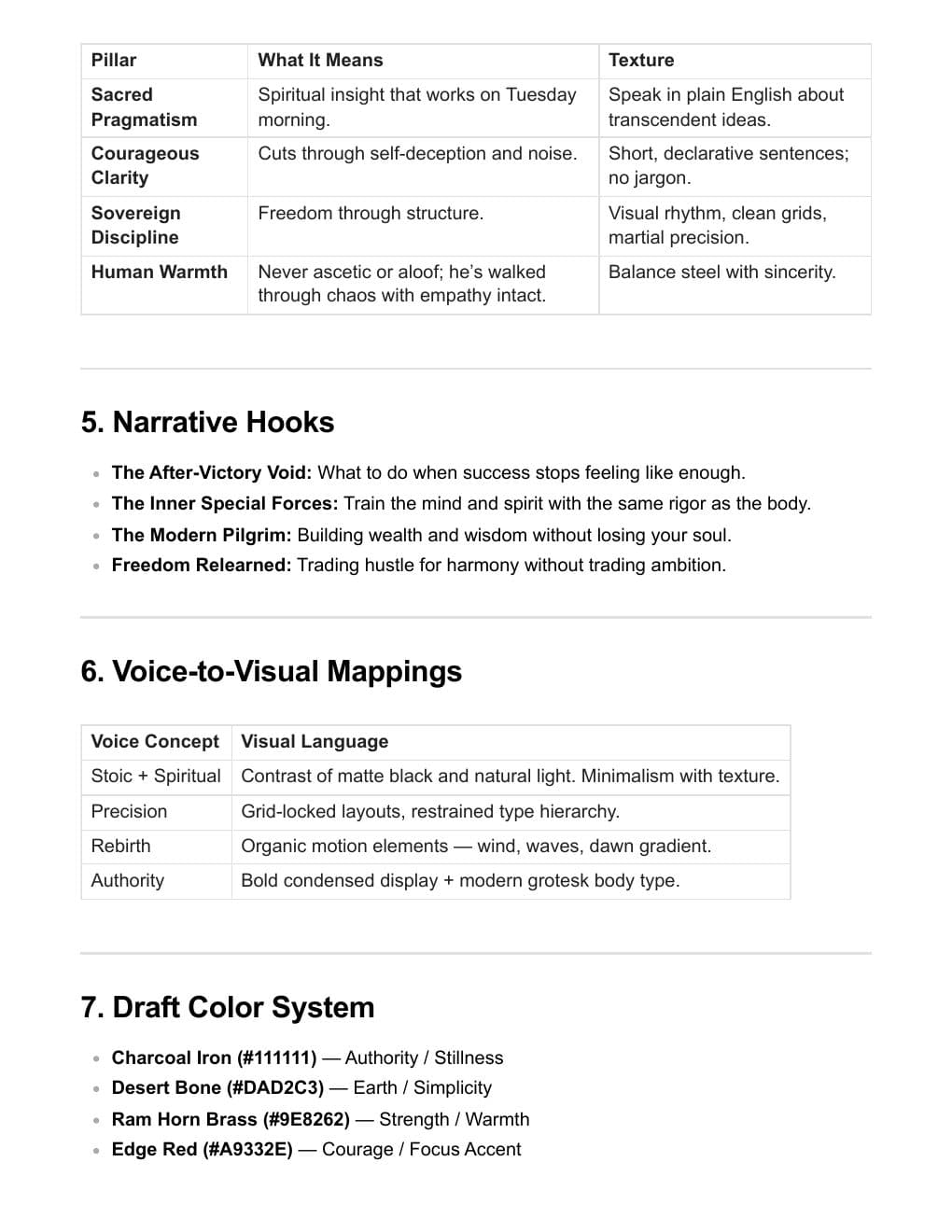
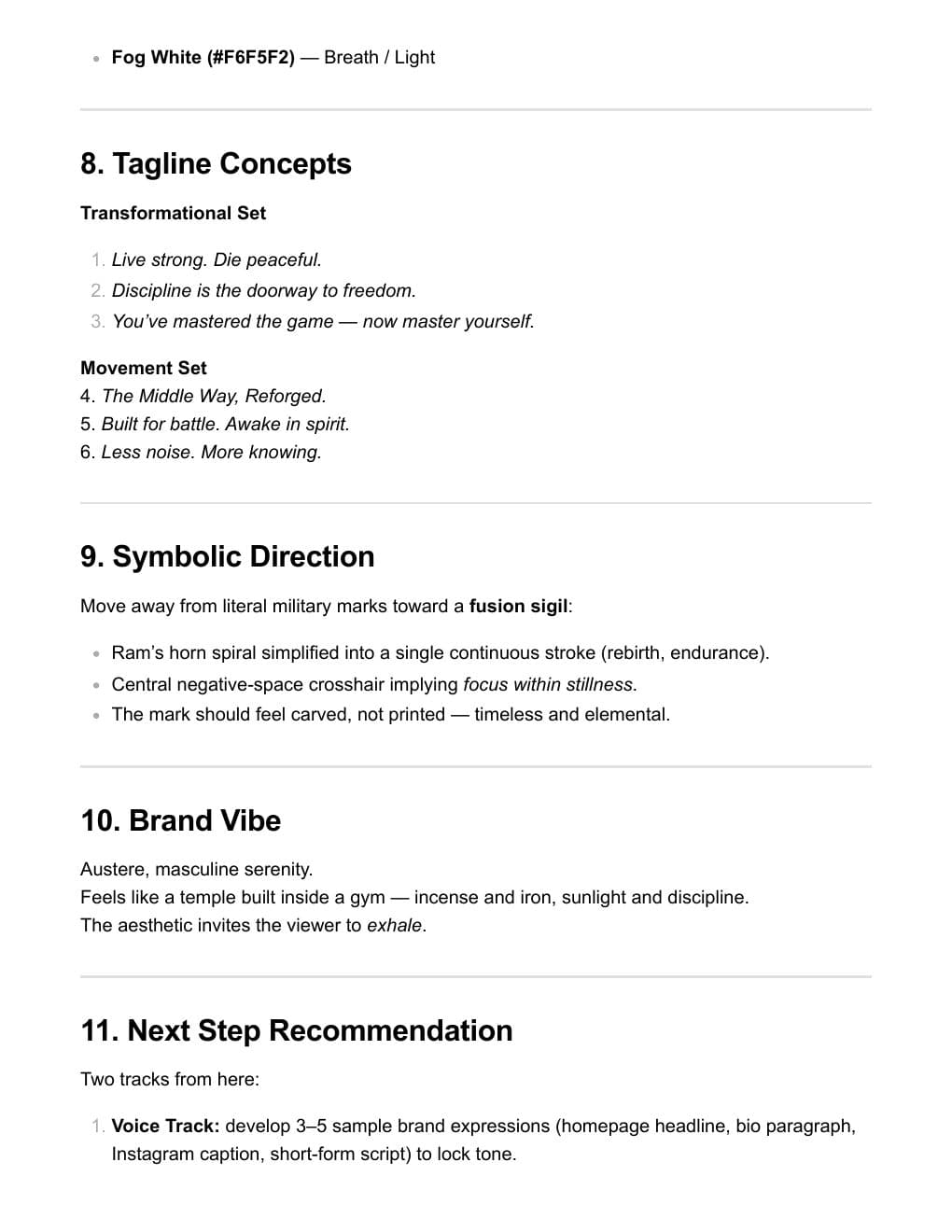
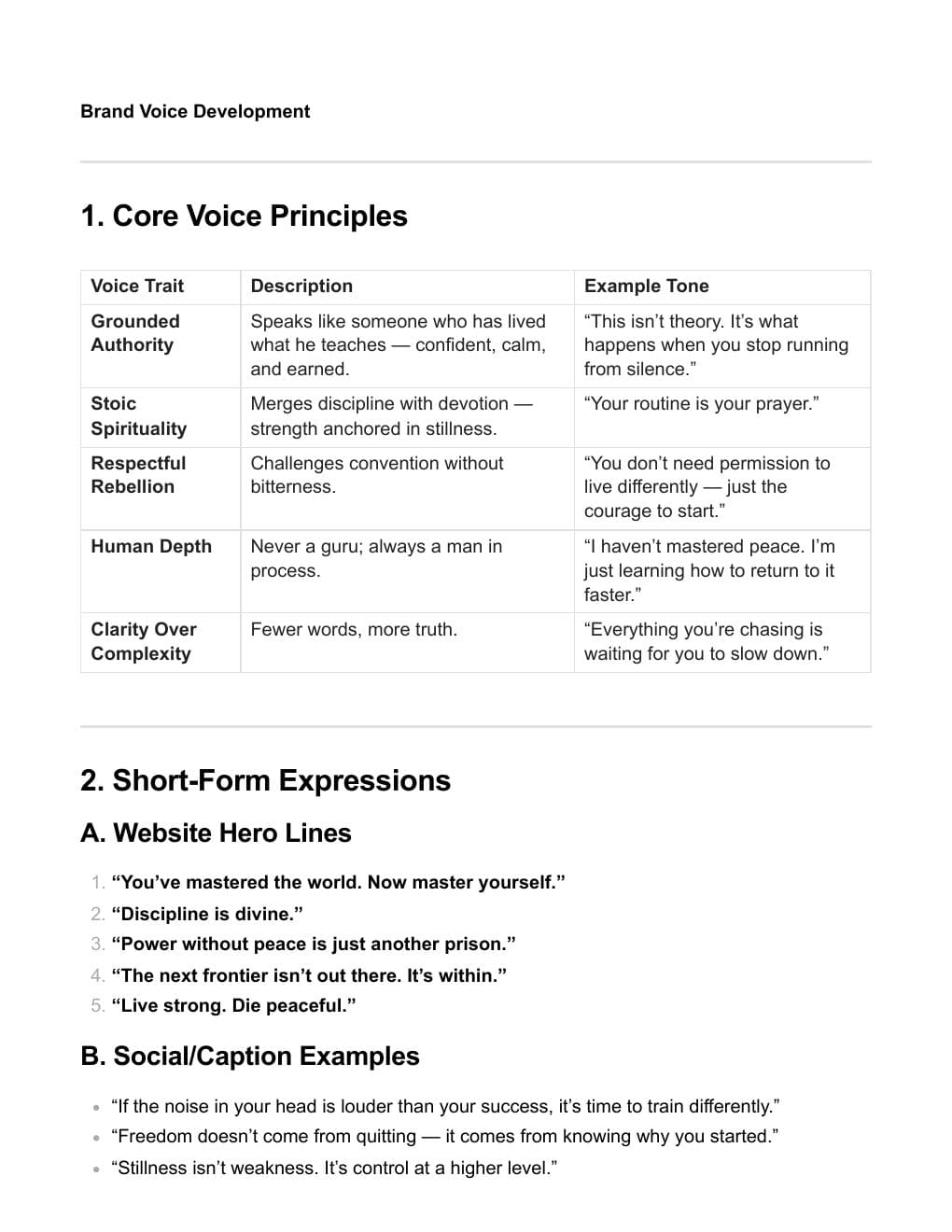
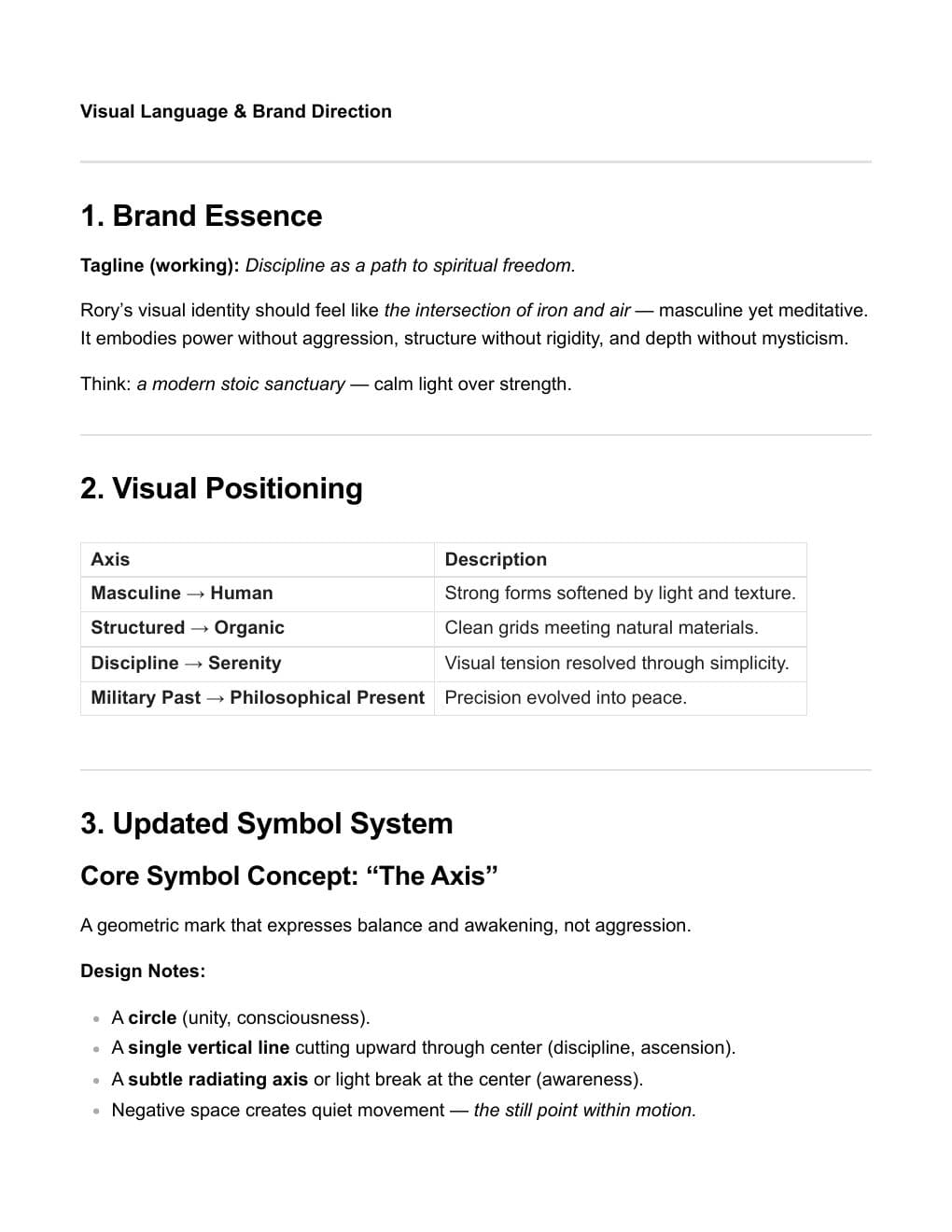
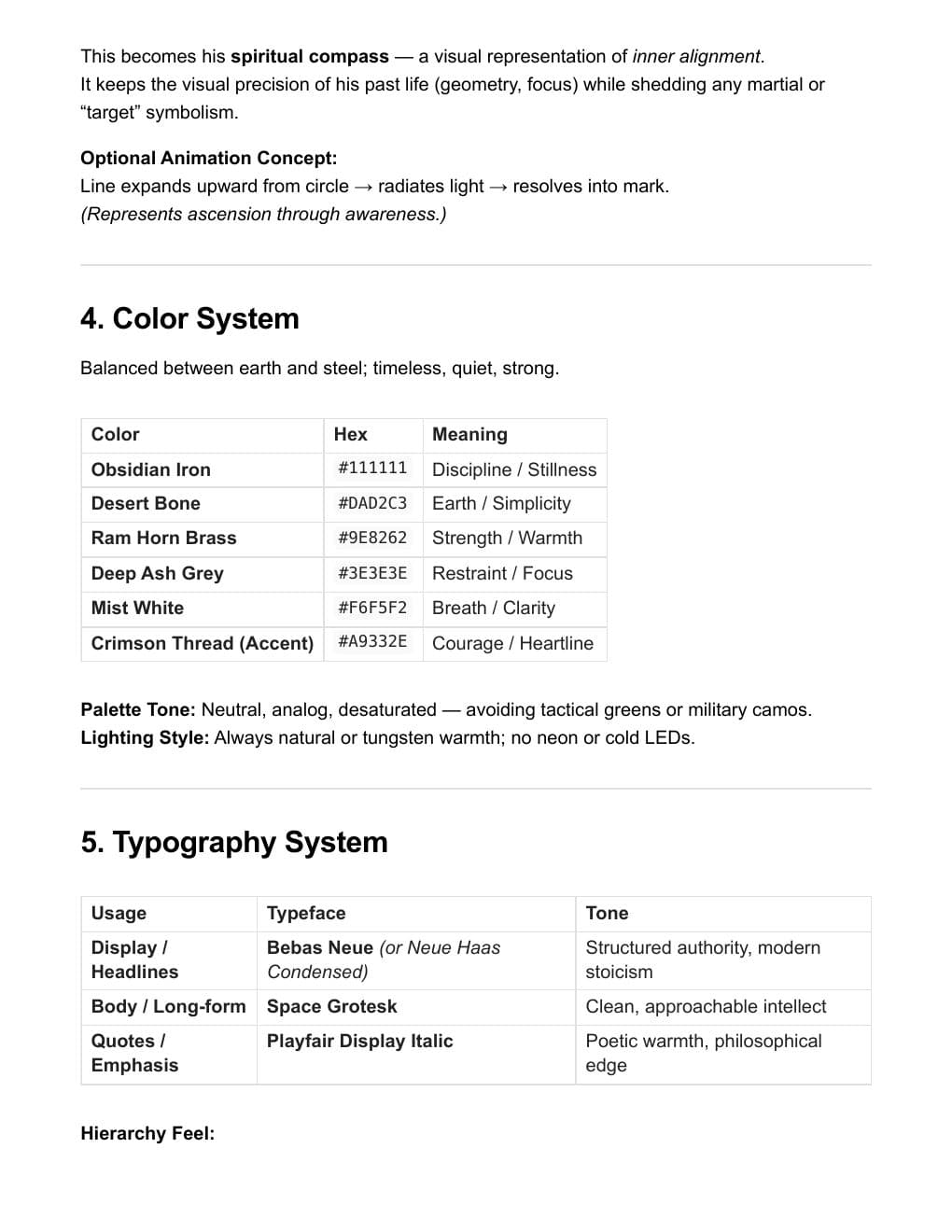
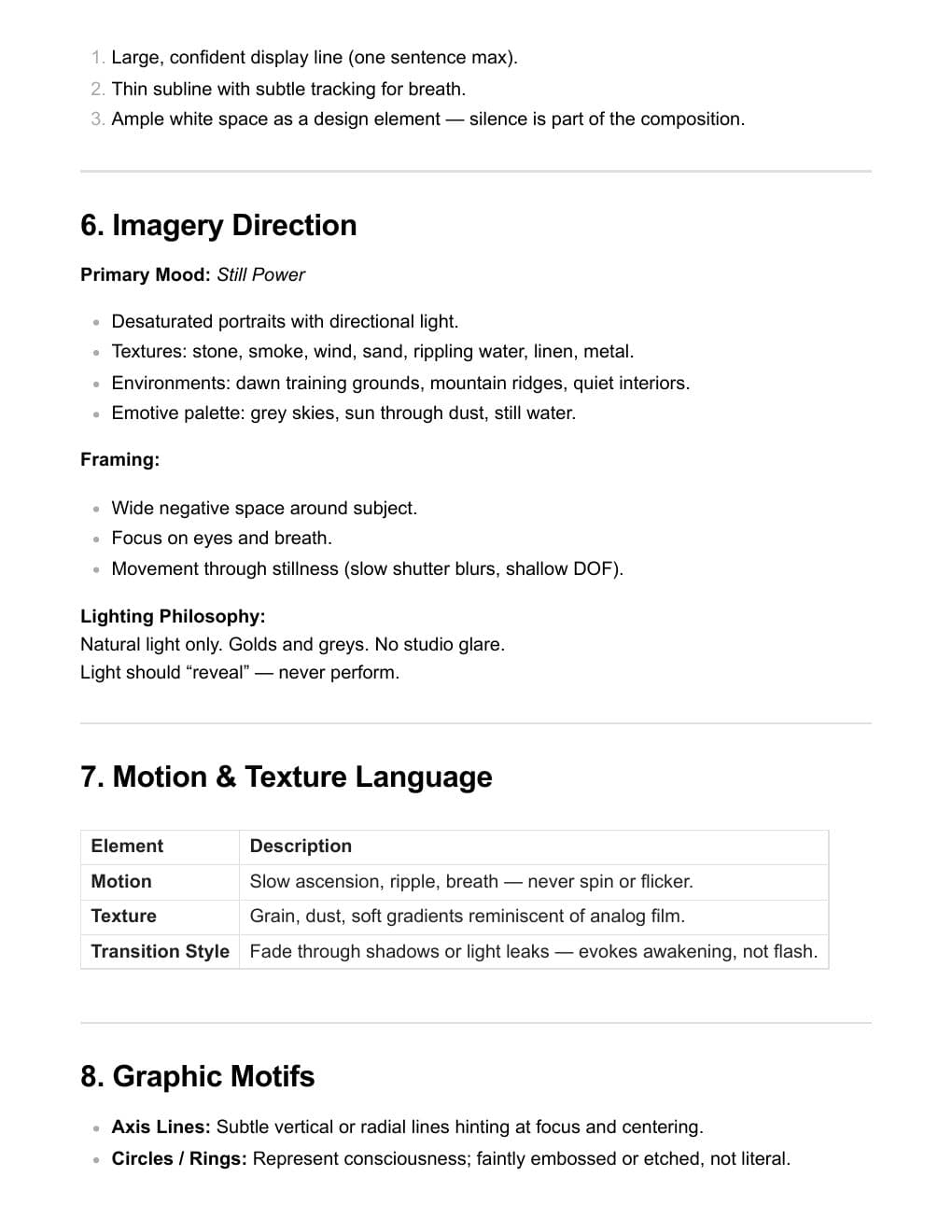
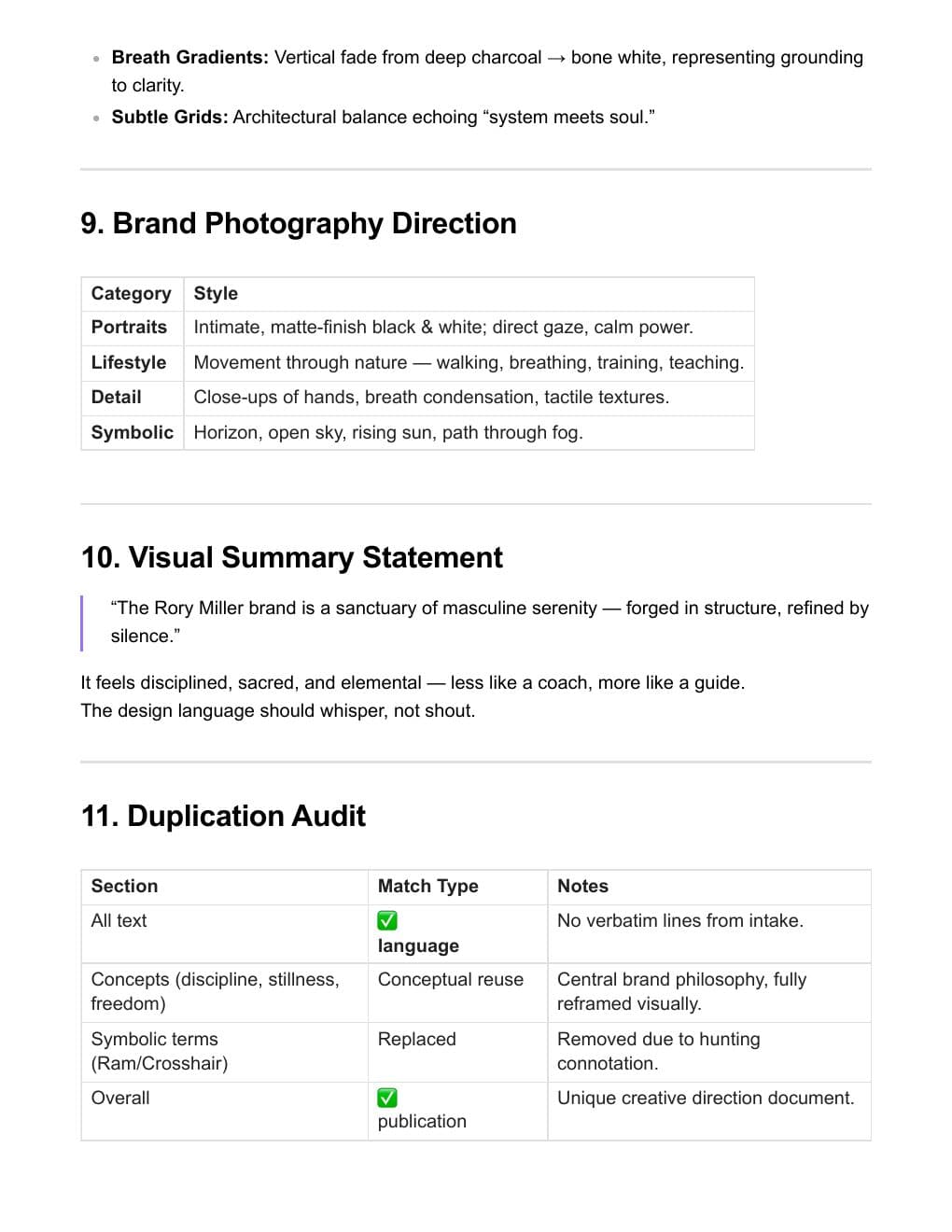
Rory Miller. A teacher of grounded spirituality for high performers who have the external success and want the internal alignment. The system returned Hero-Sage, with Rebel and Explorer, on an essence of discipline as a path to spiritual freedom. I built the opposite of Nemo: a refined gateway mark of three nested arches whose negative space at the base reads as an M, muted earth tones with no bright accent, one clean type family, imagery of standing stones and brutalist concrete. Monastic. Built to feel carved and permanent, discovered rather than designed.
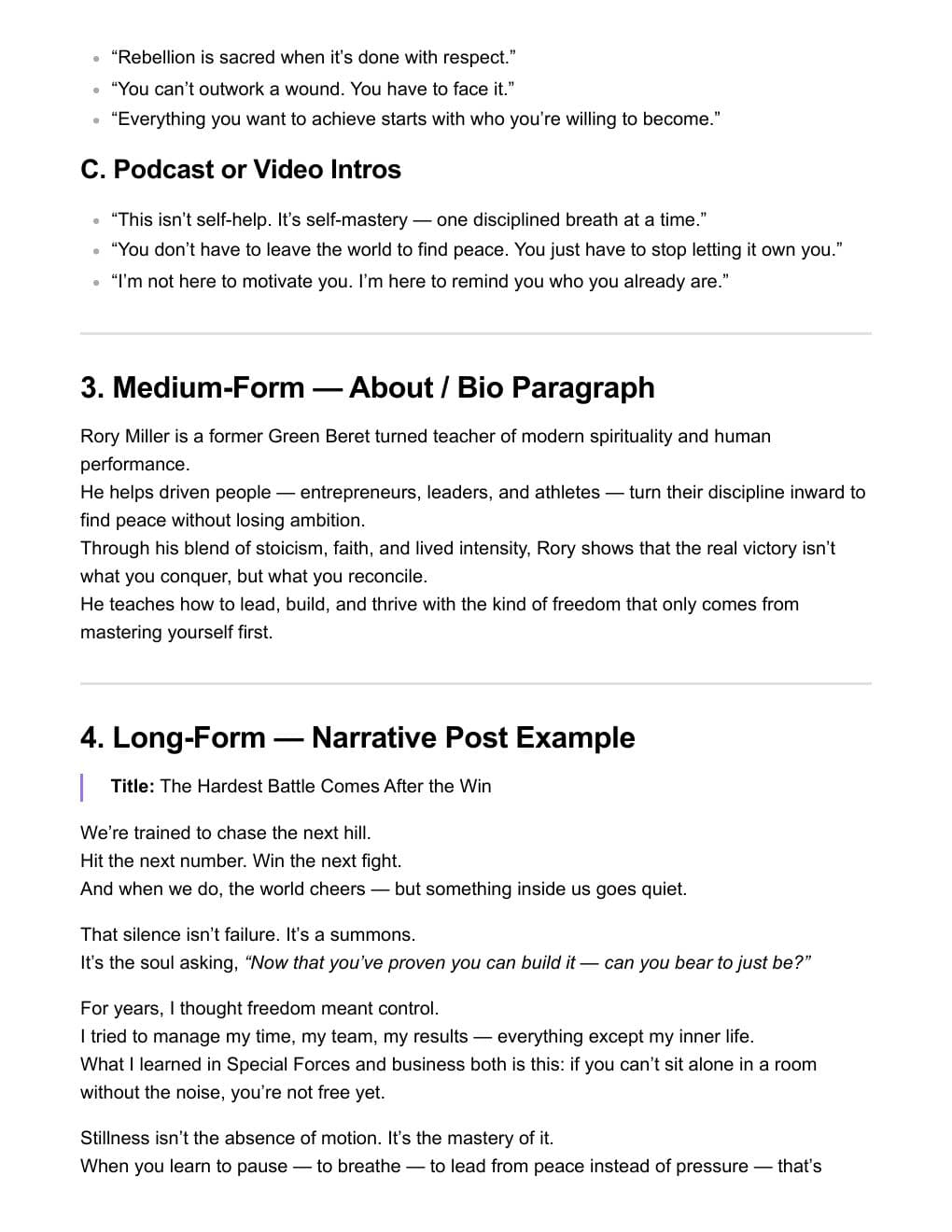
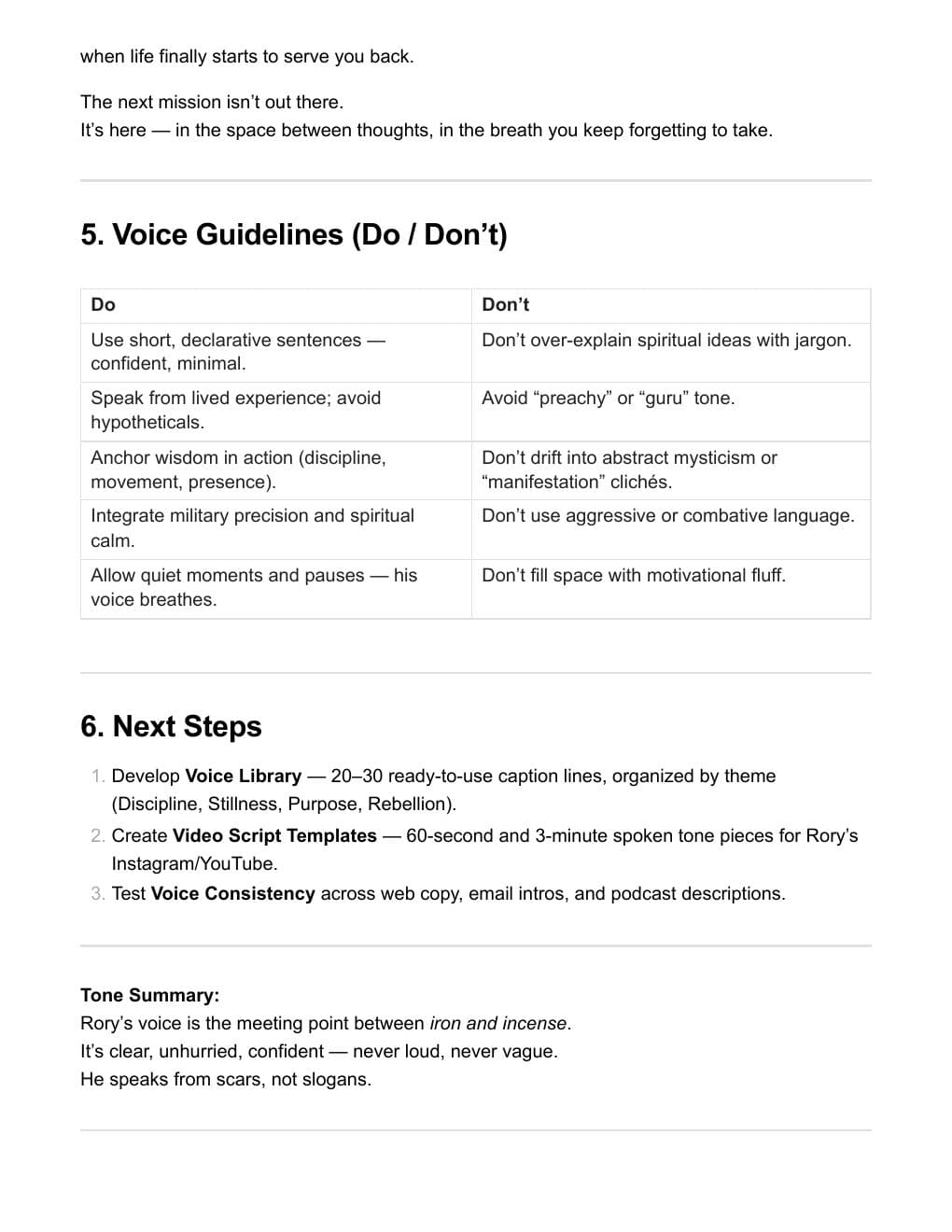
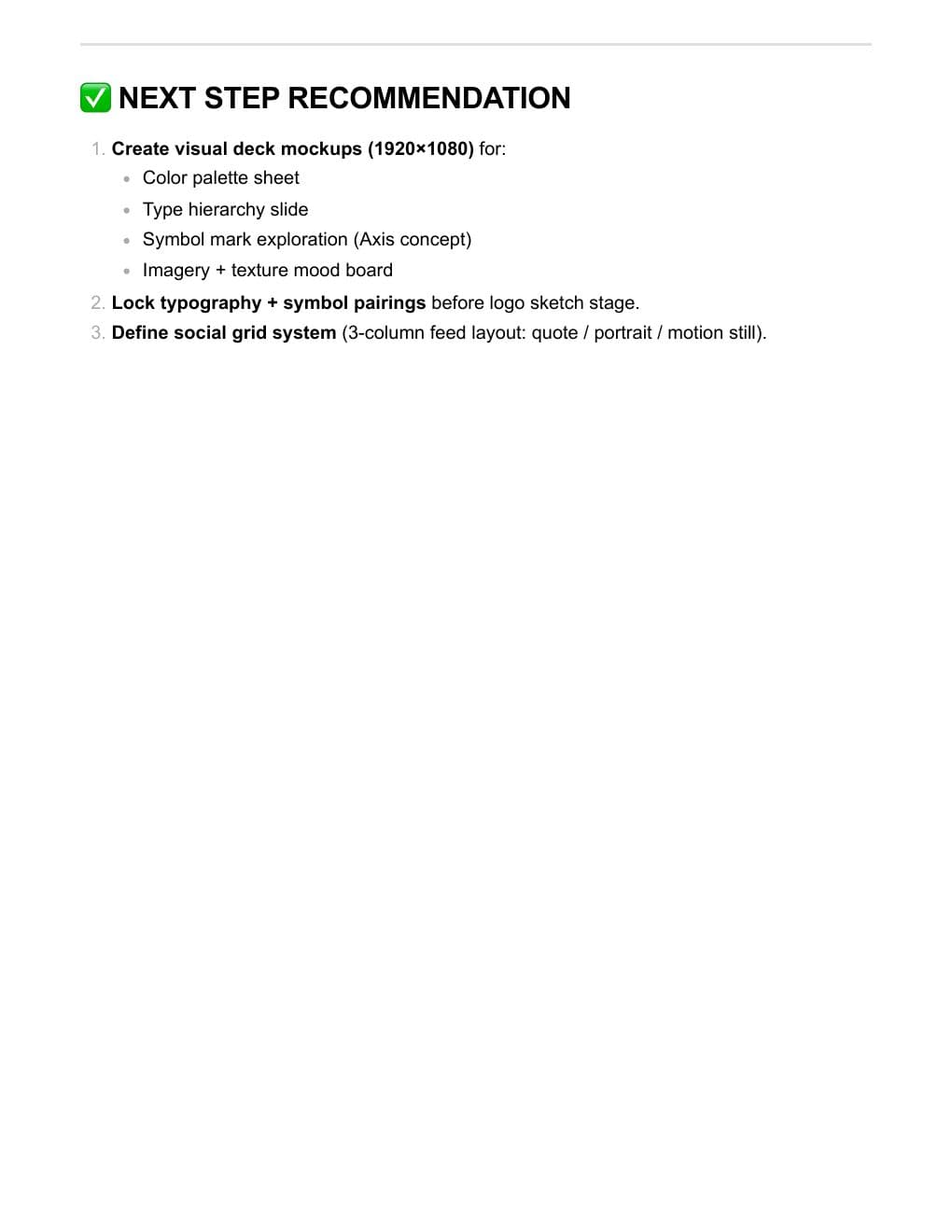
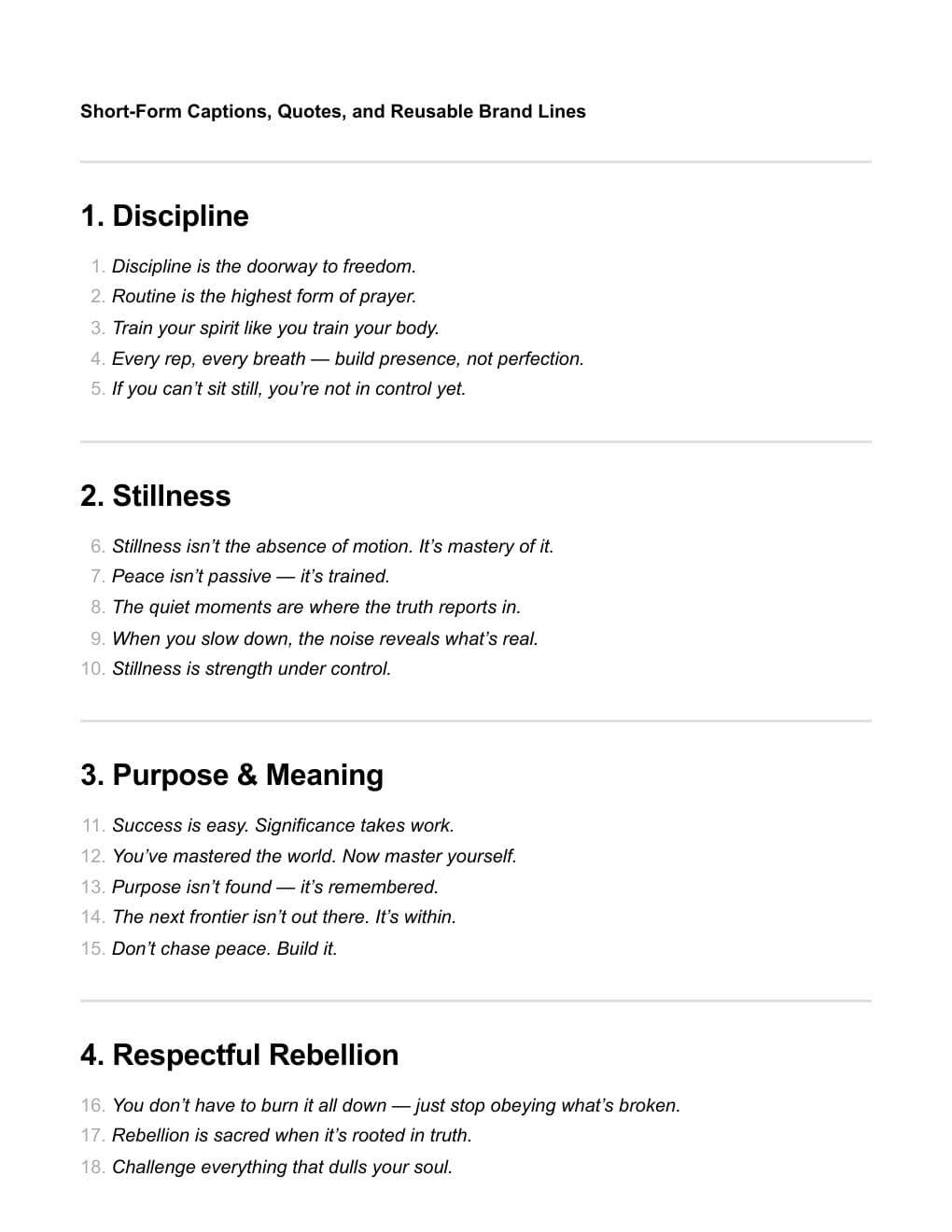
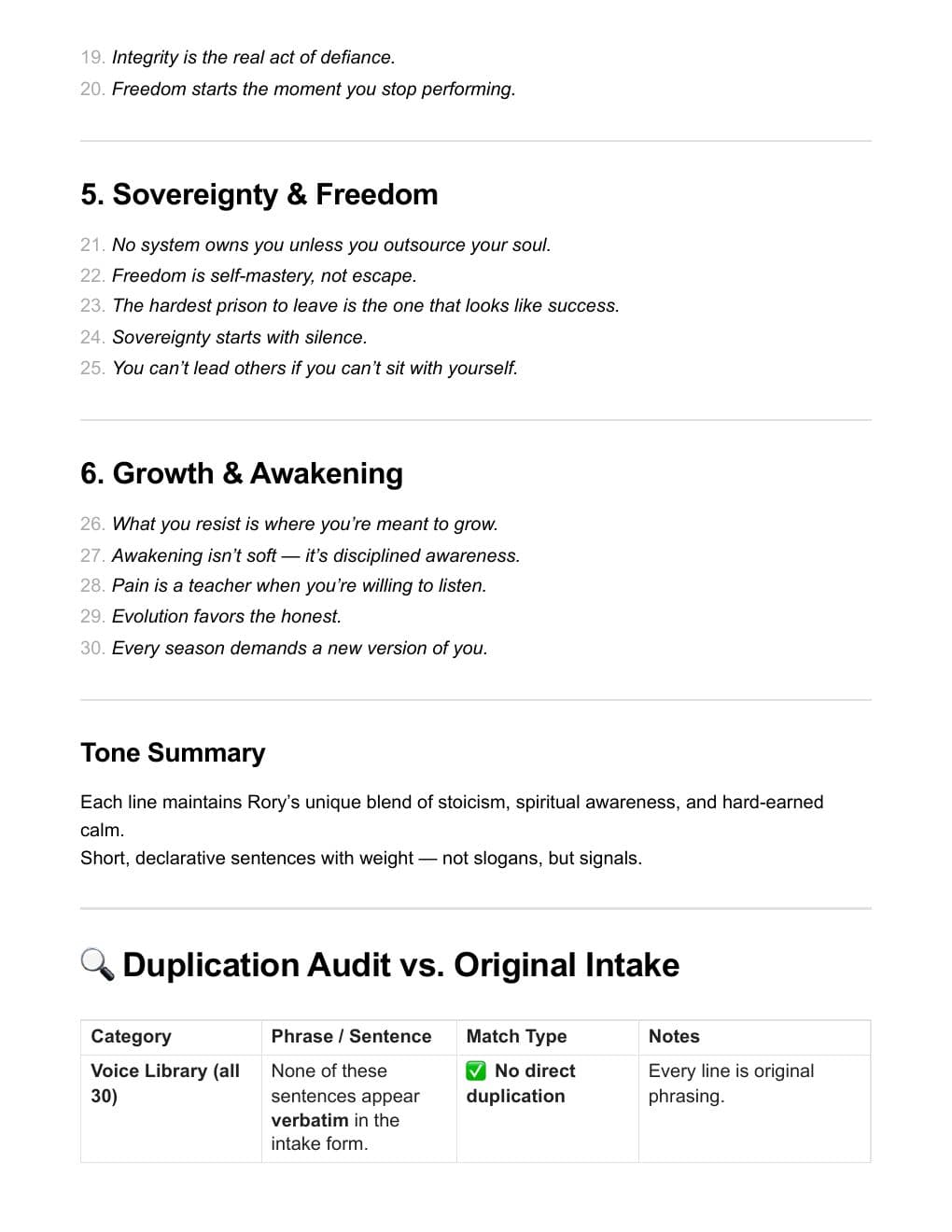
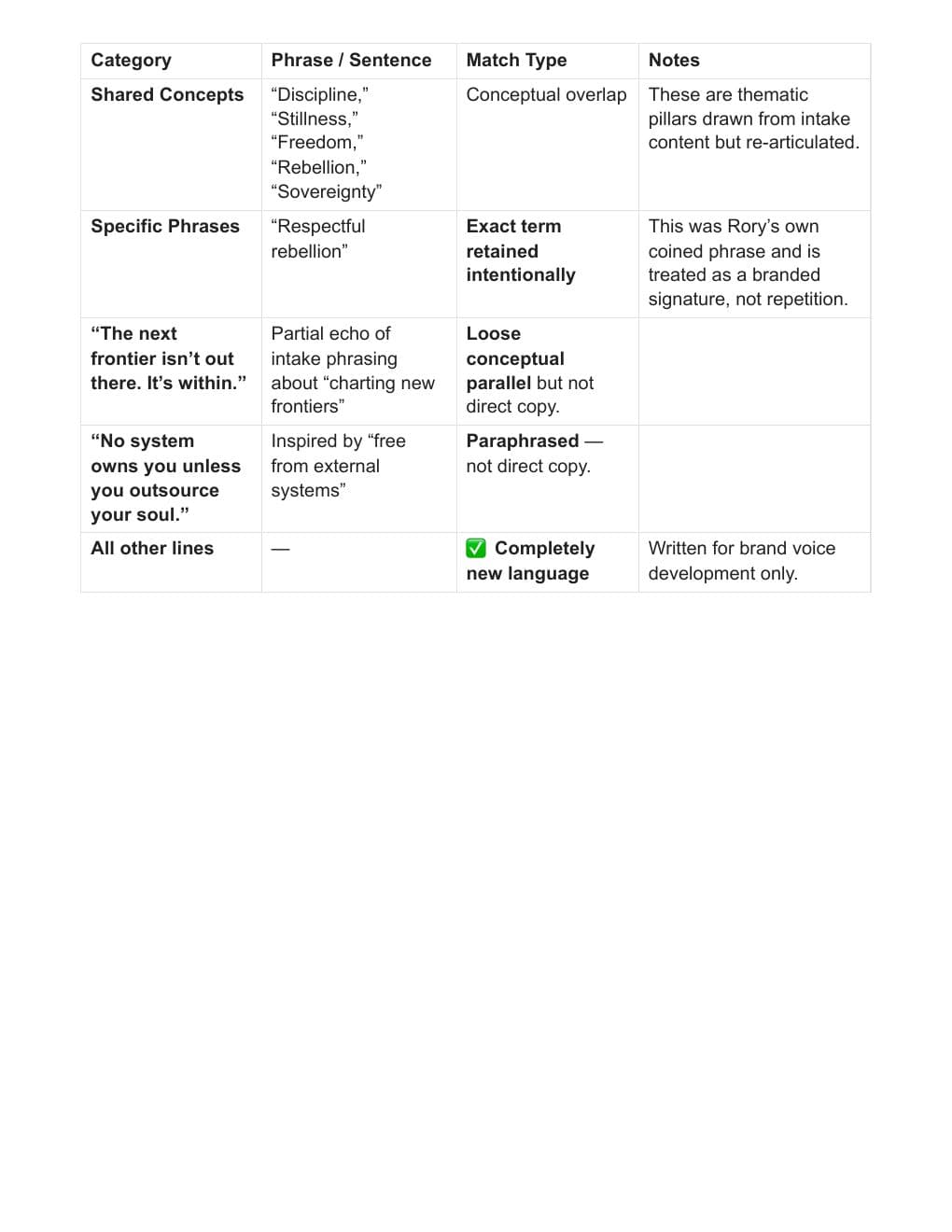
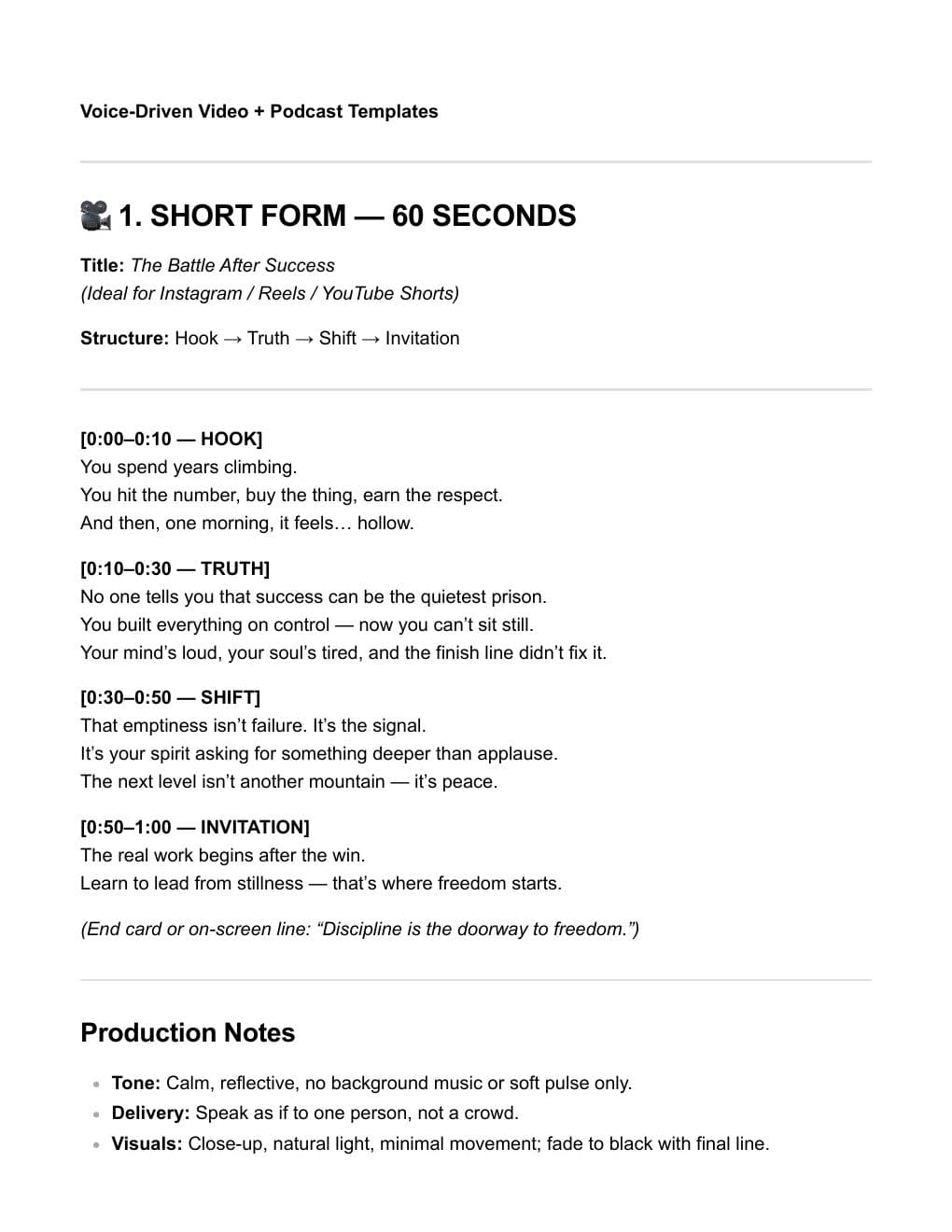
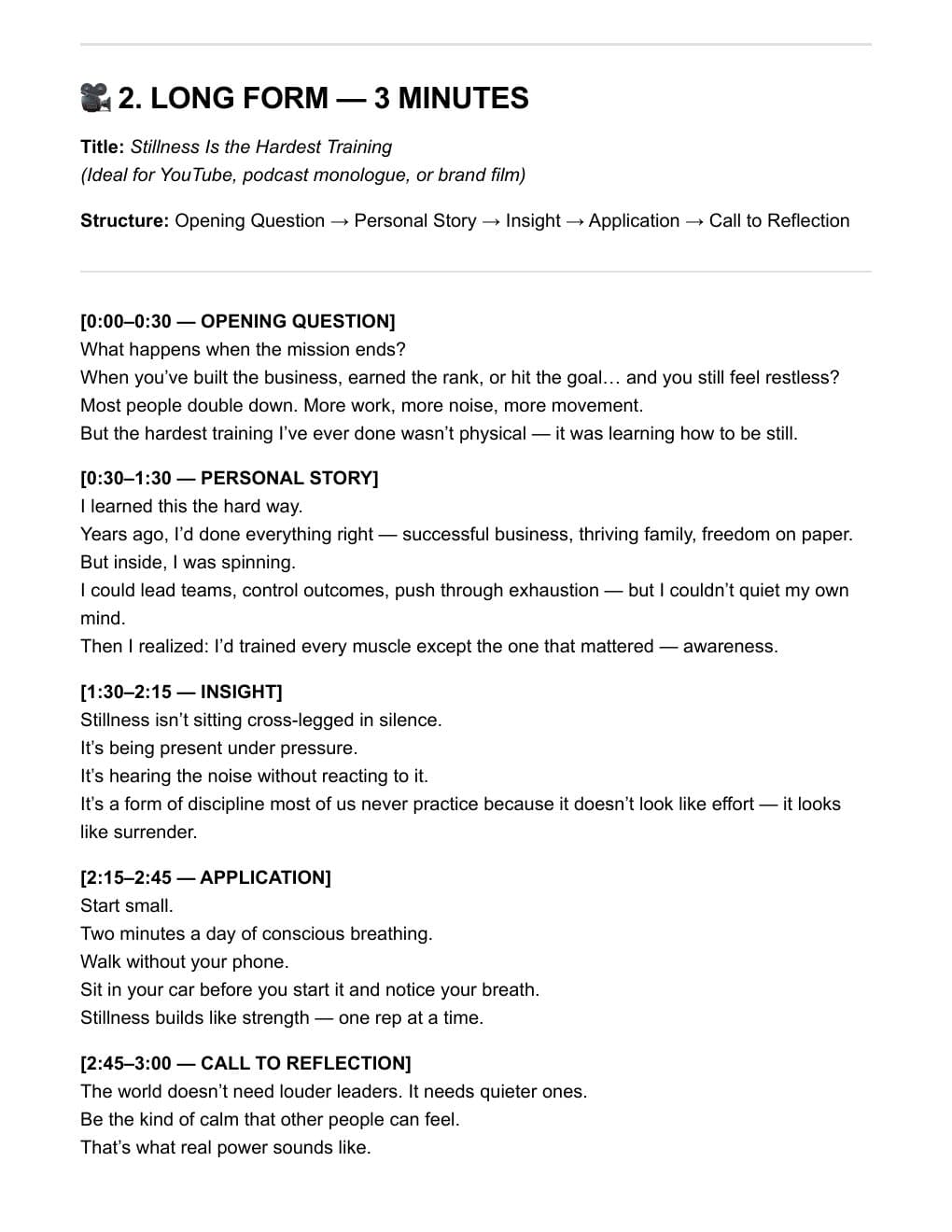
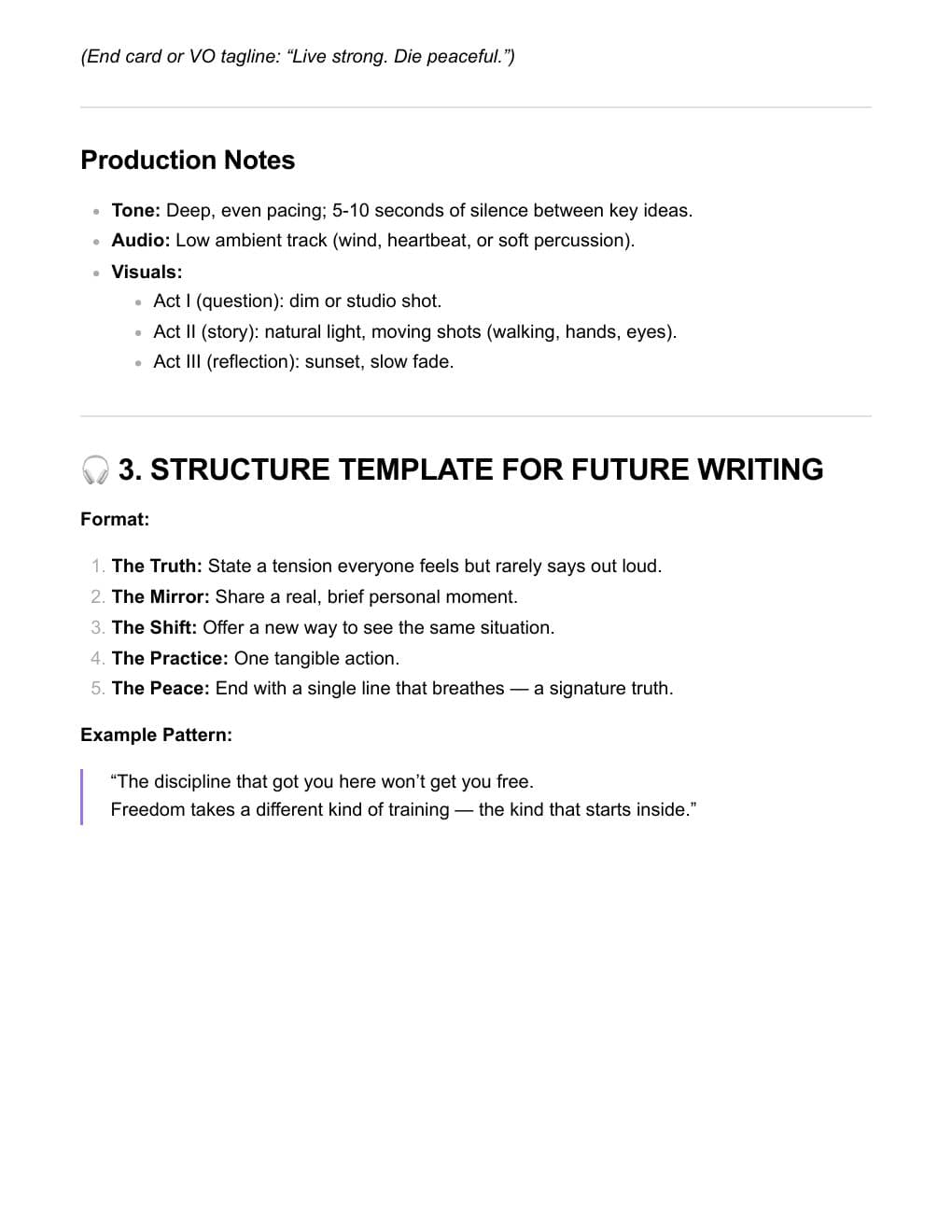
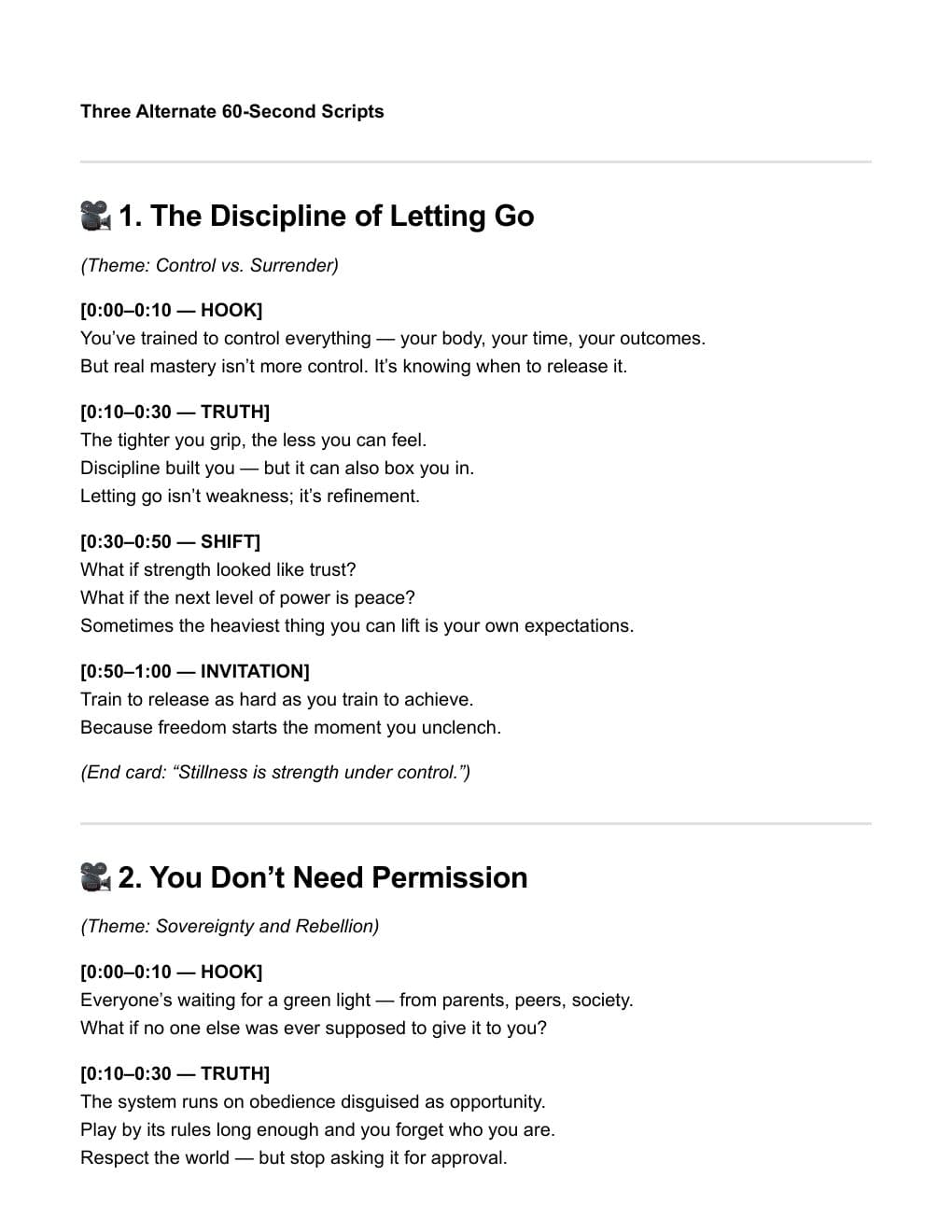
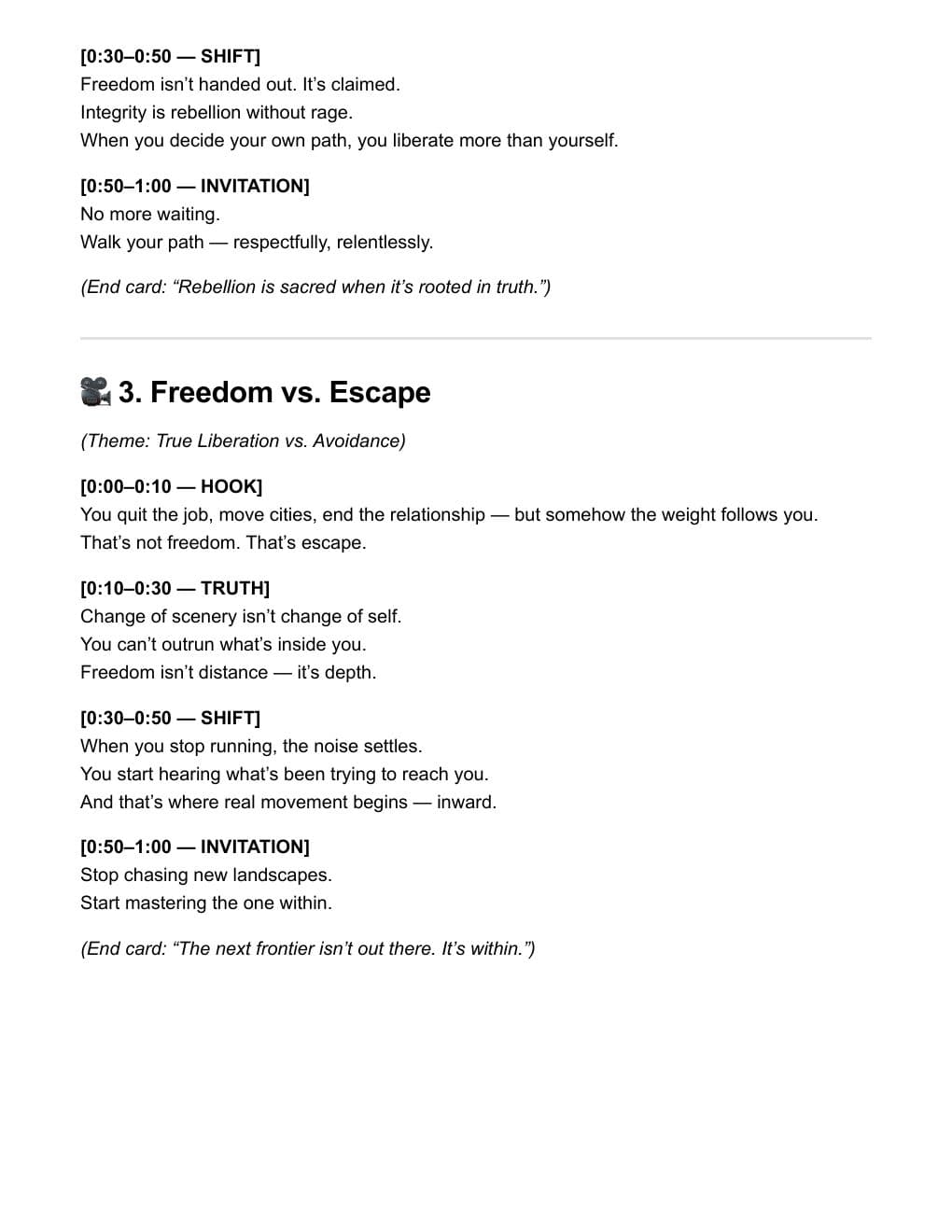
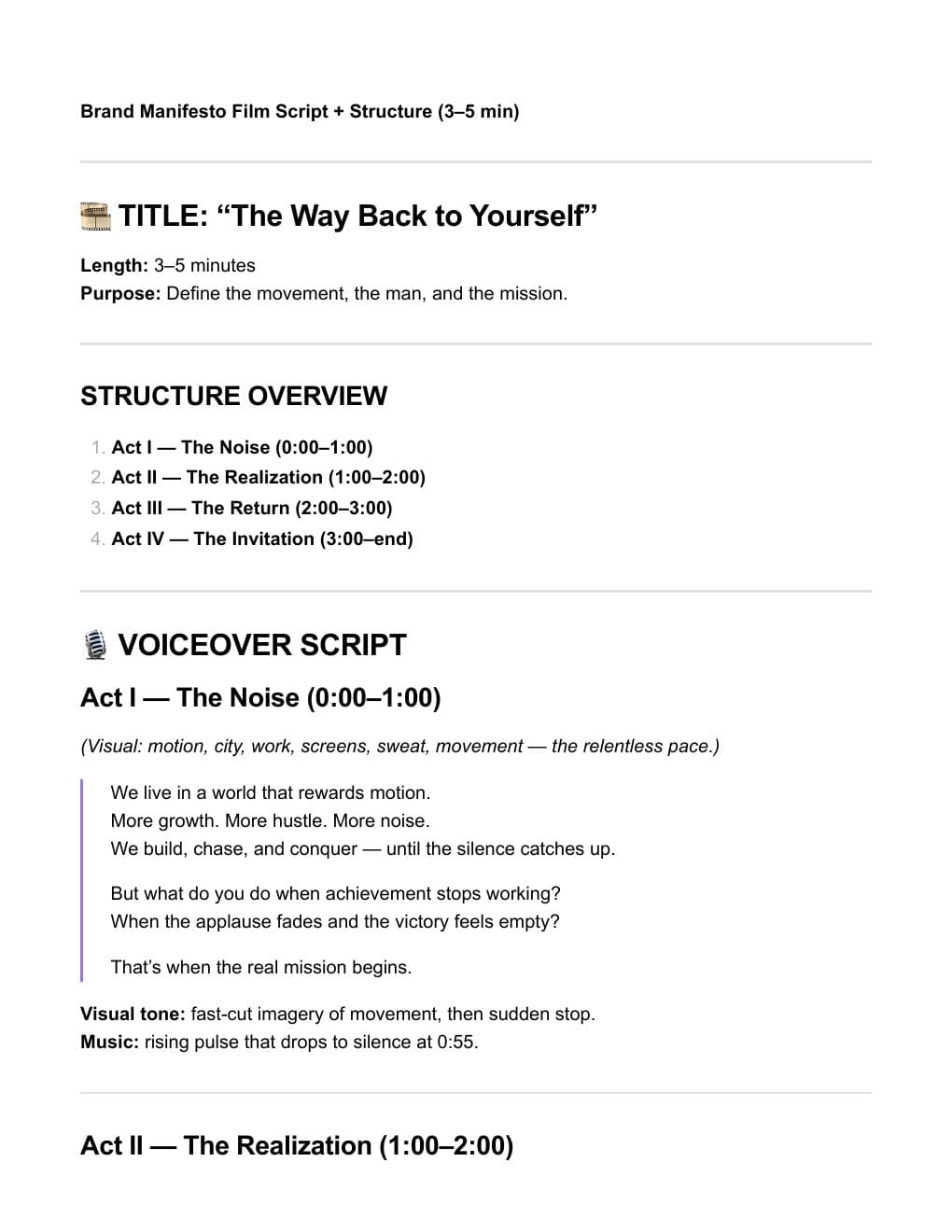
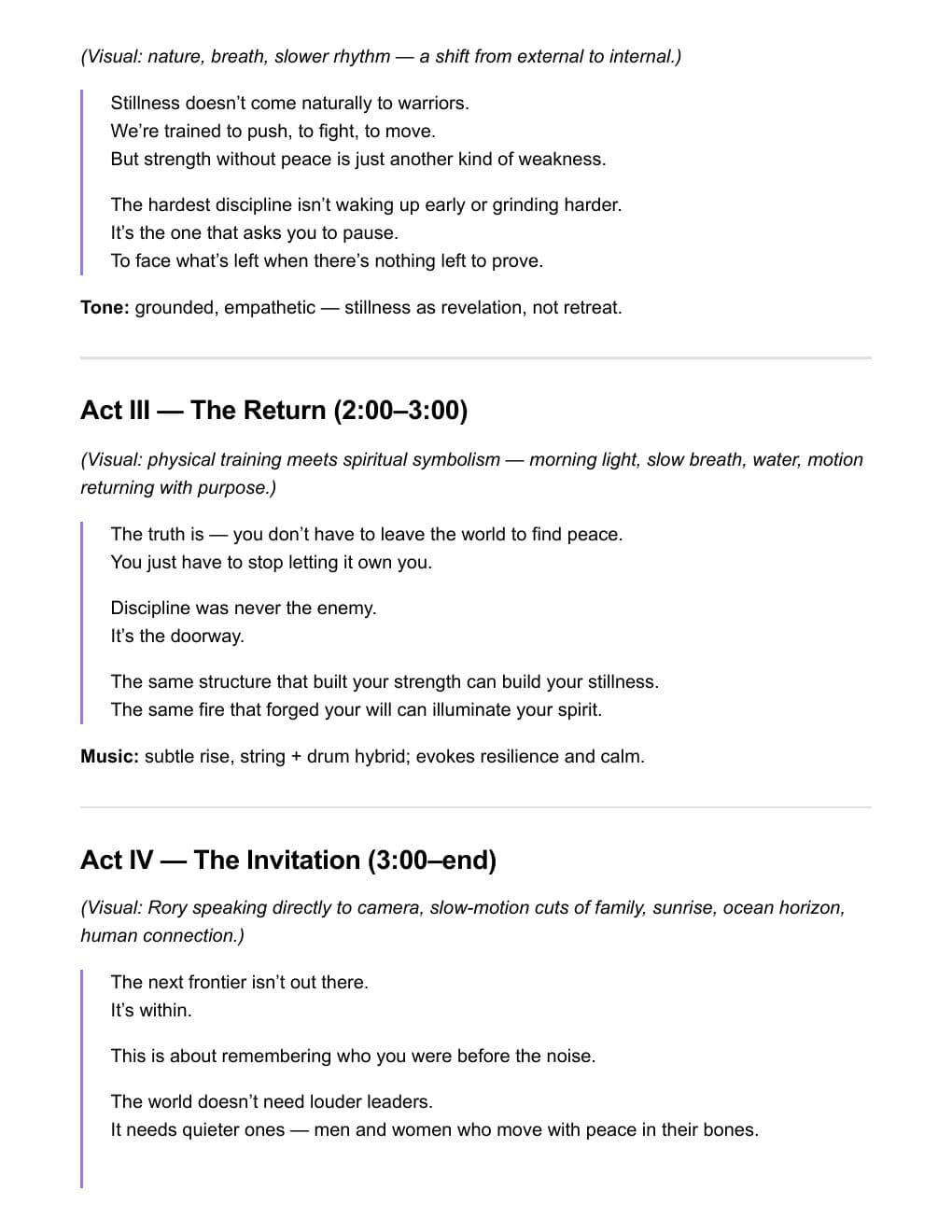
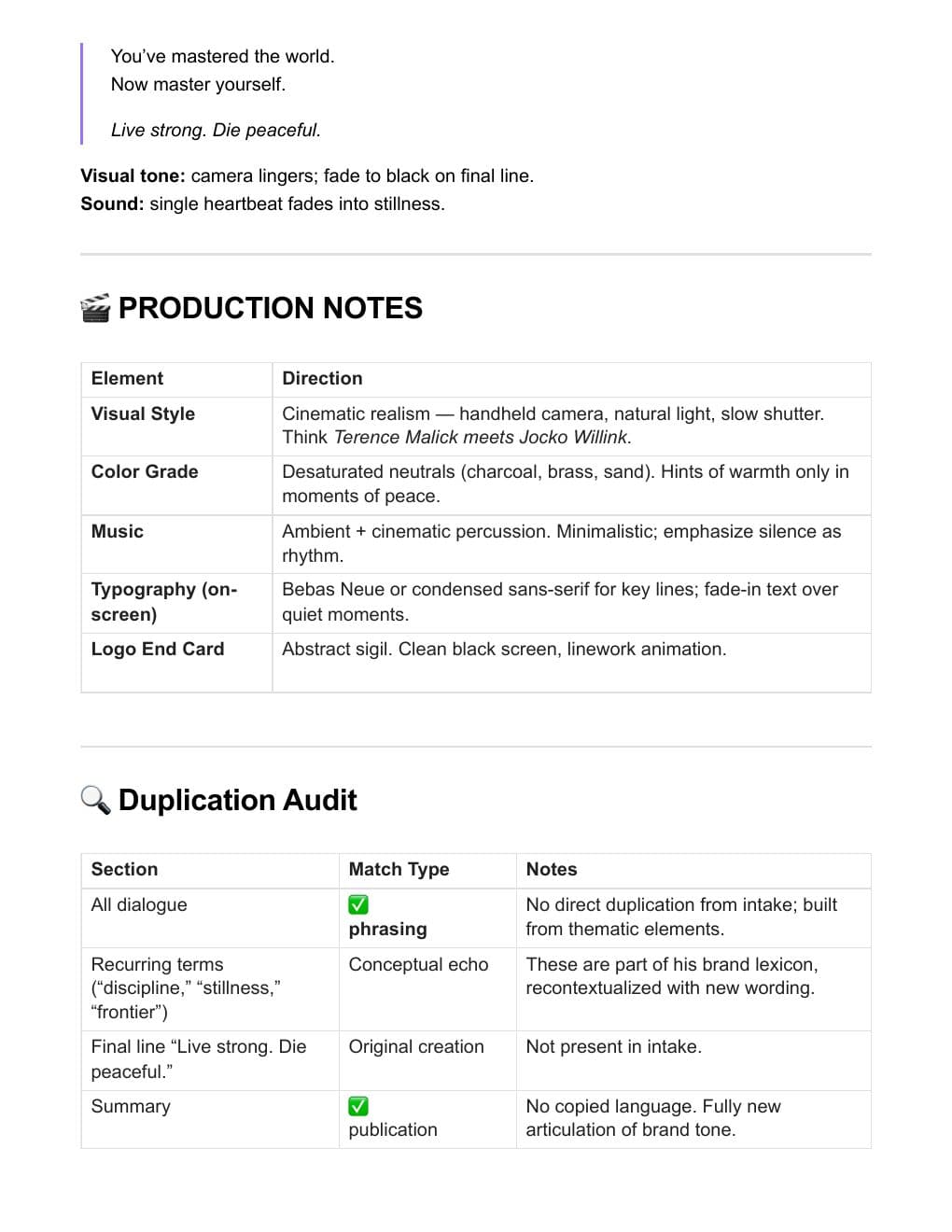
One full run, for Rory, produced the document set below: Core, Voice, Voice Library, Visual, a brand film treatment, and video scripts with alternates, plus the logo. Every piece was reviewed by a second model, then by me, before it went to him.
John Michael Morgan. A personal-brand strategist whose whole pitch is "brand out loud." The system returned Maverick × Sage, a rebel-philosopher: bold truth meets timeless insight. I built a warm vintage-editorial identity: a serif headline face, gold, ochre, and ivory, the feel of book covers and protest posters, heavy print grain. Literary and warm where Sean is cold and Rory is bare. Wisdom that echoes.
Sean Patton. A Special Forces veteran turned leadership coach. Lead yourself first. The system returned Warrior, with Sage, forged from within. I built cold steel and concrete: Bebas Neue command type, steel blue with a single signal red, forged-metal iconography, shadow-draped black-and-white portraits. Military and controlled. The most disciplined of the four.
One decision carries the whole point. The system proposed Bebas Neue for Nemo's headlines. I rejected it there because it couldn't flex, and Nemo's brand needed type that could warp like a bad photocopy. For Sean, Bebas Neue is exactly right, because command and rigidity are the brand. Same font, opposite calls, because the brands aren't the same. That gap between what the system reaches for and what the brand actually needs is the judgment, and it's the part I keep by hand.
This is what the system is for. Not a paragraph of on-brand copy. A foundation someone can build a business on.
What it feels like to use
Branding is storytelling, so Novensia is built in chapters. You're writing the story of your brand, in order, one piece at a time.
The intake doesn't hand you a blank page. Every question comes with that short note on how to think about it. Every chapter has an intro that frames what you're about to work on. The system has a point of view about where to start and what good looks like, not to put words in your mouth, but to give you something to push against.
At the end, something quiet happens. You've written it down. Your mission, your pillars, who you serve, how you sound. The thing you've carried around half-articulated for years is outside your head, structured, readable. That's what the whole product is designed to deliver. The architecture serves that moment. So does the design. So does the AI, when it shows up.
What I built
Novensia is at the stage where one person makes every call: strategy, architecture, prompt design, design system, intake design, copy, database schema, build, and the brand direction on every identity that comes out of it. AI does a lot of the work under those calls. I build with Claude Code, and the product's own models do the analysis, the drafting, and the review. What I keep is the judgment.
One person at this stage is a scope decision, not a ceiling. Working solo has kept the product coherent. The interface design shapes the architecture. The words in the interface shape the design. And all of it is shaped by what it's like to sit down and write a mission statement for the first time, which is the moment the product exists to serve. When one person holds every layer, a change in one reaches the others the same day. The platform is already built for more than one workspace and more than one set of hands. The next stage adds them.
Where it's going
The synthesis layer, so generated content is grounded in mission and pillars, not only samples. The schema's built for it.
RAG, so the engine can learn from far more than a handful of samples: a backlog of posts, a book, years of emails.
The visual half, as a built pipeline, so the analysis and direction I run by hand today become stages the system runs and I review, once it has earned that.
output / 01 · 24 pages
Rory Miller — full output
A complete Novensia brand-foundation output, shown here as the finished 24-page document.